Just got back from a full morning of sledding and chili and I'm ready to show you part 2, the Diaper and Wipes Clutch. I've made 2 of these for myeslf (lost the first one) and find it to be so convenient to have my wipes and diapers in a little sleeve. It's easy to switch it from bag to bag or throw it in the car etc. Also makes a great alternative to a diaper bag for daddies. Here's what you need:
Diaper Sleeve
exterior fabric, 1 piece 7" x 22" and 2 pieces 7" x 4" for the flap
interior fabric, 1 piece 7" x 22"
8 inches of elastic
1 snap fastener
midweight fusibible interfacing 7" x 22" and 7" x 4" (optional)
I like my sleeve to have a bit of a sturdy feel, so I fuse a mid-weight interfacing to the exterior fabric and flap. This is totally optional, but I would recommend it if you are using a lightweight fabric.
So, take your flap pieces, wrong sides together, and using a jar lid or CD, round both corner corners.
 Then, with 1/4" seam allowance and right sides together, sew around the rounded outer edge
.
Trim the seam allowance with pinking shears or clip into the curves.
 Turn, press and topstitch.
 Take your exterior piece and fold in half matching shorter sides. The fold will be the bottom of your pouch. If you want to add some applique or embroidery, this is the time to do it. I added a little brown bird to mine.
 On the back side of the sleeve, center the elastic, about 5 inches up from the folded edge. Machine baste in on sides.
 Now, unfold and fold again so that the right sides are facing and sew 1/4" seam along both long sides. Do the same for the lining fabric.
 Trim the corners and extra elastic, and turn the exterior pouch right side out. Pin the flap to the back of the pouch, matching the raw edges, and machine baste in place.
 Slide the exterior pouch inside the interior pouch, with right sides together and pin along the top.
  With a 1/2 inch seam allowance, sew around the top, leaving an opening for turning.
 Turn and press. Pin the opening closed, and top-stitch making sure to sew the opening closed.
 Add a snap, fill with diapers and you're ready to go.
Don't forget to fold up your changing pad and slip it into the elastic on the back.
 Now go change some diapers in style!
 On one of my many trips to the fabric store, I picked up this great green, sort of houndstooth, flannel in the remnants bin. 1 yard for $1.50....I just couldn't resist. Lately I'm feeling like the last thing I need is more fabric, so today I pulled it out and decided to make a diaper changing set. Lots of my friends are pregnant, and I'm sure one of them would love this little set. Here's what you need to make your own:
Changing Pad
fabric 14" x 20", cut 2
vinyl 14" x 20, cut 1
2 yards of 1/2" double fold bias tape
 Lay out the fabric rectangles with wrong sides together and place the vinyl on top. Machine baste along the shorter sides to keep everything in place.
 Starting in the middle of one of the sides, sew on the bias tape by placing the fabric/vinyl sandwich in the middle and sewing along the edge of the tape. Make sure you are catching both sides as you sew. This is not the "proper" way to sew bias tape, but it works and is quicker than the "proper" way.
Dana over at Made just had 2 nice posts on making your own bias tape and the proper and "cheating" way to sew bias tape.
 To miter the corners, sew to the end of the side. Turn your bias tape and fold over at the corner.
 Continue to sew all the way around, finishing the corners the same way. When you get to where you started, fold under the raw edge and cover your starting point.
 There you have it! A great, wipeable changing pad. Easy, peasy. I'm ready for bed, so I'll show you the diaper/wipes pouch in my next post.
When I was a kid, we always had homemade yogurt. My parents grew up in India and it was just part of the daily routine. At some point we switched to buying it at the store and it never phased me one way or the other. My parents have started making it at home again, and I decided it's time to give it a try. It's actually really simple and cheaper than buying it at the store. Here's what you'll need:
 Double boiler (can use just a regular pot, but be careful not to burn the milk)
metal spoon
kitchen thermometer
milk (any fat content will work, I used non-fat)
yogurt starter (any plain yogurt with active cultures)
 If you're using a double boiler, boil the water with your spoon in the pot to sterilize it. Since you're going to be leaving your milk out for 7 hours, you don't want to "contaminate" it
.
I don't actually know how necessary this is. I read that you should do this, but my parents don't and never have.
 Add your milk to a pot and bring the milk to 185F while stirring. If you don't use a double boiler, you have to be very careful not to burn the milk.
 Place the pan with the milk in a bowl of cold water and allow it to cool to 110F. Make sure to stir occasionally so that it cools evenly.
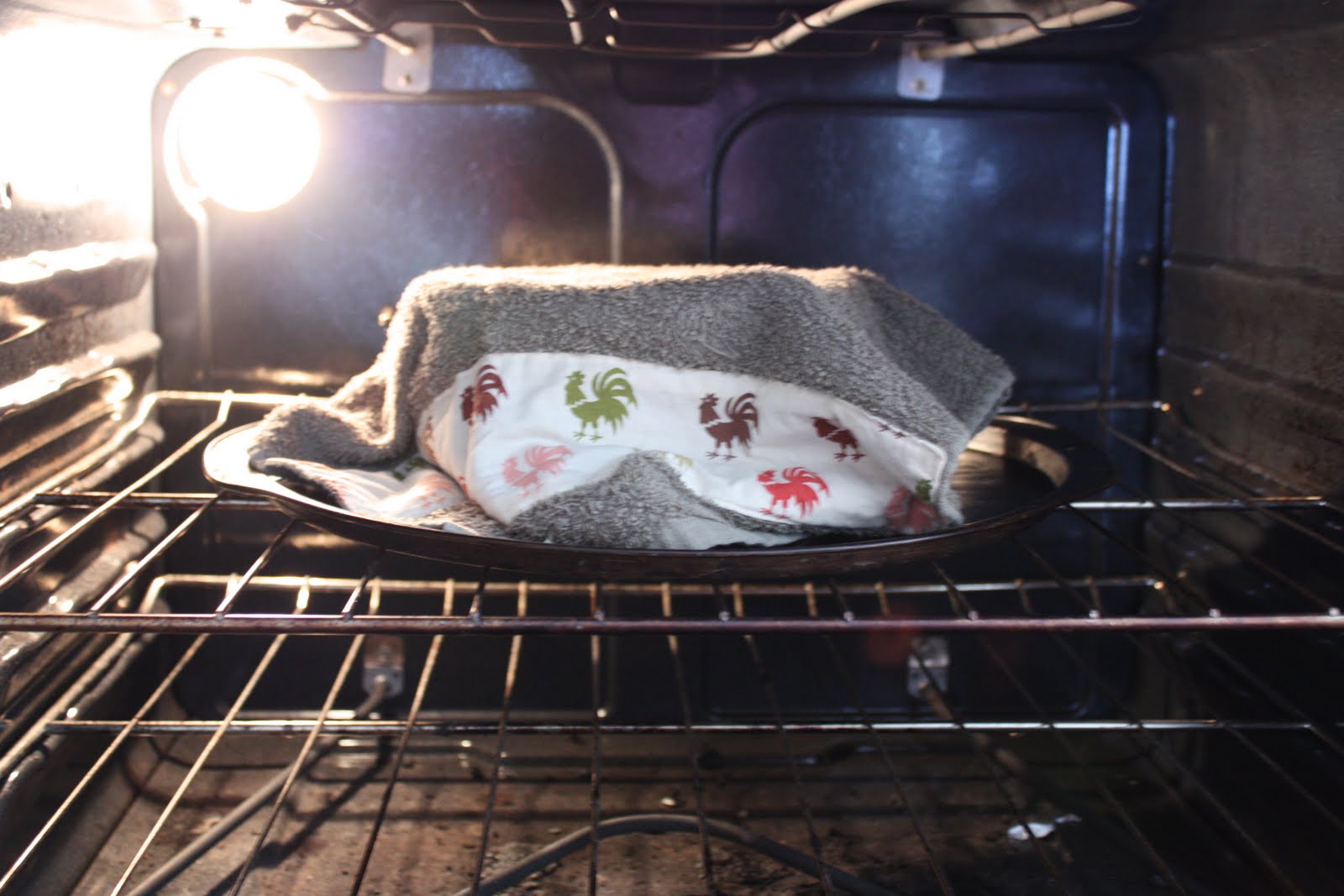
 At this point I warmed my oven up a little. Just set it to the lowest setting and turned it off after about 5 minutes.
Once the milk cools to 110F, mix in 1-2 tablespoons of your starter, which can be any plain yogurt with active cultures. I think you can buy powdered yogurt starter too, though I'm not sure where. Now you want to "incubate" your milk and cultures. Sorry, the scientist in me is creeping in. I wrapped a towel around my container and kept the oven light on to keep it warm in the oven. I think ideally you don't want the temperature to be above 100F and you want your container to sit undisturbed for 5-7 hours.
It was soooo hard for me to not open the oven and check...
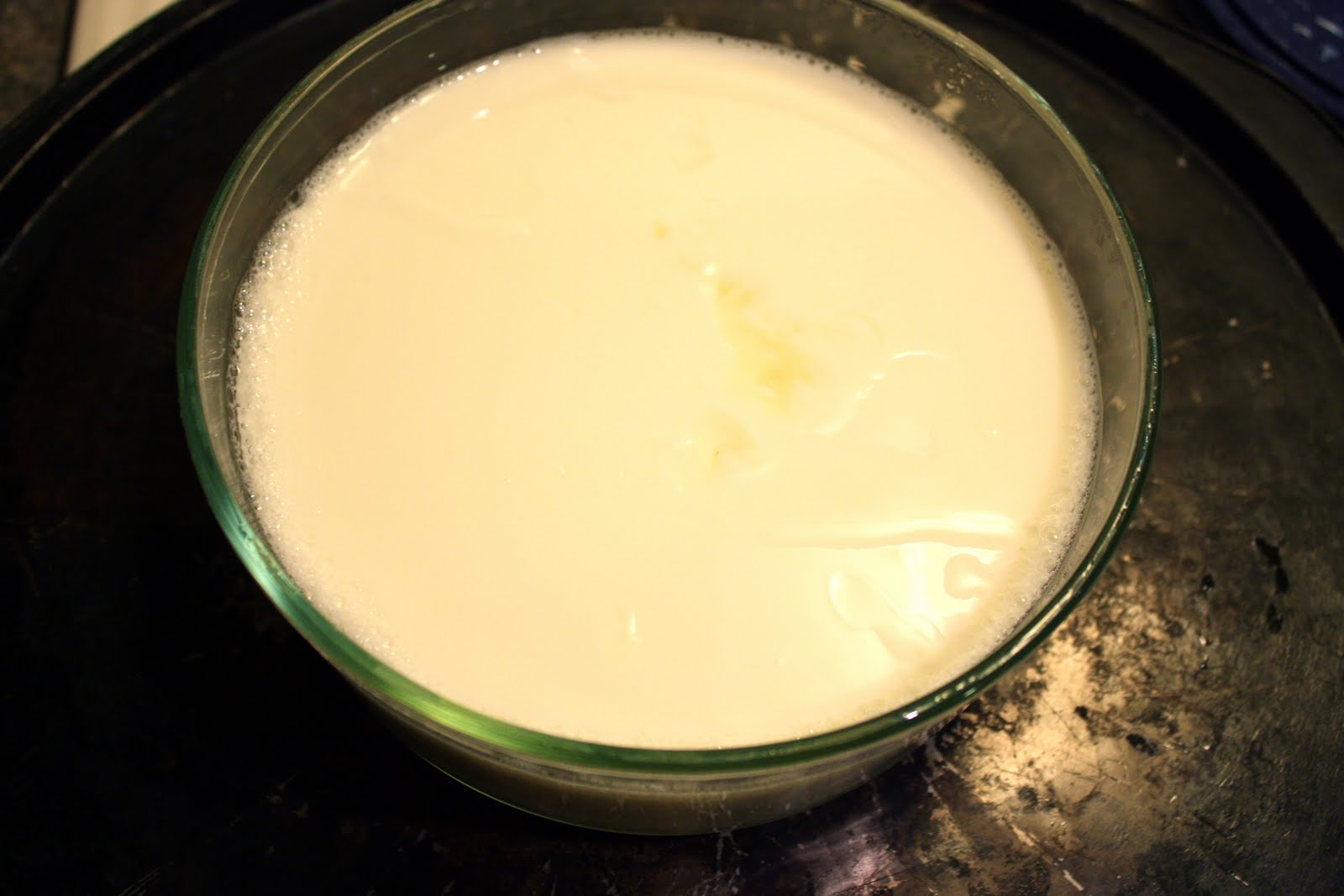
 But, I was able to exercise some restraint and checked after the 7 hours and voila, I made yogurt! It's hard to tell from the photo, but it's solid, and has a little liquid on top
.
At this point, you stir it up and refrigerate and you can be done. You've got homemade plain yogurt.
I decided to go a step further and make mine into that luscious creamy "greek" style yogurt. Basically all you do is remove the liquid by straining it through a coffee filter.
 Place the coffee filter in a colander over a pot. Add the yogurt and wait a few hours.
 It goes from this
 to this
.
So,the scientist in me can't help but do a little math. I started with 7 cups of milk, a little less than half a gallon. I ended up with 4 cups of greek yogurt. Here in W. Mass, a gallon of organic milk costs about $4.00 and would make 8 cups or a half gallon of organic greek yogurt. The greek yogurt I buy costs about $3.50 for 4 cups (32oz). So, the savings for making your own is about $3/gallon. Not a huge savings...but still something and fun to do.
The kids enjoyed helping to make and eat our homemade yogurt. We all enjoyed a bowl with maple syrup at lunch.
 I had mine with maple syrup and pecans. A yummy and healthy treat.
 Note: If you want to keep making yogurt, you should save a little each time to use as starter for the next batch.
Enjoy!

 Just got back from a full morning of sledding and chili and I'm ready to show you part 2, the Diaper and Wipes Clutch. I've made 2 of these for myeslf (lost the first one) and find it to be so convenient to have my wipes and diapers in a little sleeve. It's easy to switch it from bag to bag or throw it in the car etc. Also makes a great alternative to a diaper bag for daddies. Here's what you need:
 Then, with 1/4" seam allowance and right sides together, sew around the rounded outer edge. Trim the seam allowance with pinking shears or clip into the curves.
 Turn, press and topstitch.
 Take your exterior piece and fold in half matching shorter sides. The fold will be the bottom of your pouch. If you want to add some applique or embroidery, this is the time to do it. I added a little brown bird to mine.
 On the back side of the sleeve, center the elastic, about 5 inches up from the folded edge. Machine baste in on sides.
 Now, unfold and fold again so that the right sides are facing and sew 1/4" seam along both long sides. Do the same for the lining fabric.
 Trim the corners and extra elastic, and turn the exterior pouch right side out. Pin the flap to the back of the pouch, matching the raw edges, and machine baste in place.
 Slide the exterior pouch inside the interior pouch, with right sides together and pin along the top.
  With a 1/2 inch seam allowance, sew around the top, leaving an opening for turning.
 Turn and press. Pin the opening closed, and top-stitch making sure to sew the opening closed.
 Add a snap, fill with diapers and you're ready to go.

 Now go change some diapers in style!